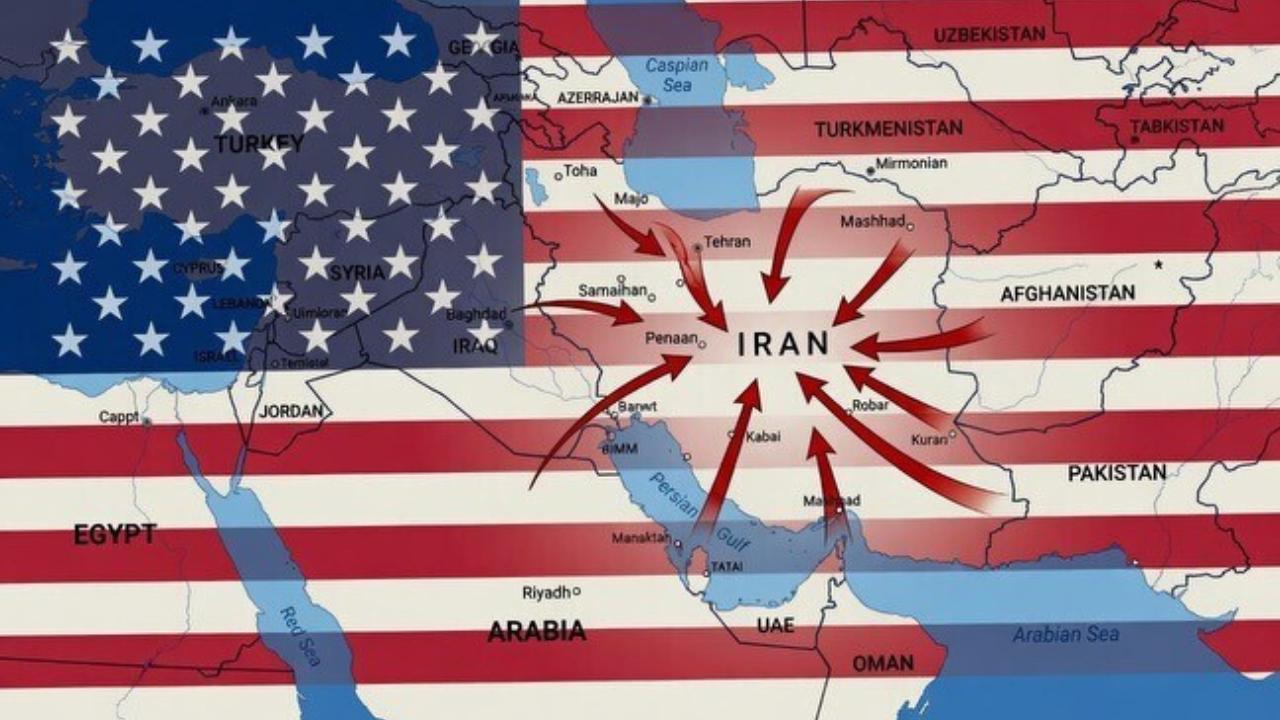
A wordless, AI-generated image shared on social media is driving global energy markets and military planning rooms into a frenzy. US President Donald Trump posted a map of the Middle East draped in the American flag, with sharp red arrows converging directly on Iran. This visual maneuver is not just erratic digital posturing. It signals the imminent collapse of a fragile, Pakistan-mediated ceasefire and a calculated shift toward a massive regional escalation. Behind the curtain of social media rhetoric lies a harsh geopolitical reality: Washington is demanding total capitulation from Tehran, and the window for a diplomatic resolution is virtually shut.
The timing of this digital salvo tells the real story. Hours before the image appeared, Trump issued a blunt ultimatum online, warning Tehran that "the clock is ticking" and that they must move fast or "there won't be anything left of them." This public hardening of Washington’s position followed a high-level discussion between Trump and Israeli Prime Minister Benjamin Netanyahu. Observers who dismissed the post as mere theater missed the highly coordinated policy shift unfolding underneath.
The Illusion of Peace
The Middle East has been balanced on a razor's edge since joint US and Israel military strikes hit targets inside Iran on February 28. While a Pakistan-negotiated truce established a shaky ceasefire on April 8, it was always a temporary pause rather than a path to peace. The reality on the ground has remained incredibly hostile.
Diplomatic talks have completely stalled because both sides are operating on incompatible demands. The White House has laid down non-negotiable terms for a permanent settlement.
- Iran must surrender hundreds of kilograms of enriched uranium.
- Tehran must restrict its entire nuclear infrastructure to a single facility.
- Iran must drop all demands for war compensation.
- Frozen Iranian assets abroad will remain blocked until all conditions are verified.
Tehran viewed these demands as an existential threat and rejected them outright. Iranian President Masoud Pezeshkian fired back, accusing the West of trying to destabilize the country while demanding an immediate halt to all Western military operations, the release of frozen assets, and formal recognition of Iranian sovereignty over regional waters.
With both sides dug into immovable positions, the ceasefire has effectively expired in everything but name. Trump’s shared map is a public acknowledgment that Washington has moved past the negotiation phase.
Choking the Global Energy Artery
The core of this confrontation is not just a battle of political wills. It is an economic war centered on the Strait of Hormuz, the world's most critical energy chokepoint.
During peacetime, roughly 20 percent of global oil exports pass through this narrow waterway. Right now, the strait is under an effective blockade. Iran’s Islamic Revolutionary Guard Corps (IRGC) recently raised the stakes by publishing its own map, formally delineating a claimed area of control and warning all commercial vessels to coordinate with Iranian naval authorities or face severe risks.
Trump’s response has been characteristically unyielding, even mockingly referring to the body of water as the "Strait of Trump" to assert American dominance. The practical consequence of this geopolitical game of chicken is catastrophic for global commerce. Commercial tankers are refusing to risk the passage, leaving the vital shipping lane completely empty.
The Pentagon is not waiting to see if diplomacy makes a miraculous comeback. Behind the scenes, military planners are preparing for Operation Epic Fury 2.0. This contingency plan involves expanded kinetic strikes targeting Iranian domestic infrastructure, energy facilities, and nuclear sites if negotiations remain frozen. The red arrows on the map are a literal representation of the Pentagon's multi-front containment strategy, tracing the physical positions of US naval assets in the Persian Gulf, active operations in Iraq and Syria, and the mobilization of regional allies.
The Failure of Maximum Pressure
The current crisis highlights the fundamental flaw in relying solely on economic and military intimidation. Decades of Washington policy have assumed that enough pressure will force Tehran to break. This strategy fails to account for the internal survival mechanisms of the Iranian regime. When backed into a corner, Iran does not capitulate. It projects power outward through asymmetrical warfare and shipping disruption.
A common counter-argument among Washington hawks is that a decisive, overwhelming strike could permanently neutralize Iran's nuclear ambitions and regional influence without triggering a total war. This is dangerous wishful thinking. A major strike on Iranian soil would almost certainly trigger a regional chain reaction, activating proxy networks across the Levant and shutting down the global energy supply for months.
Acknowledge the gray area here. Iran is feeling the pressure of economic isolation, but its leaders view compliance with Trump's current terms as domestic political suicide. By leaving no room for a face-saving compromise, US policy has turned a diplomatic exit into an impossibility.
The Strategic Shift
The current situation differs significantly from previous standoffs. The involvement of major outside powers has shifted the calculus. Trump’s recent diplomatic visit to China and the shifting priorities of South Asian mediators like Pakistan show that the conflict is no longer a localized issue.
We are seeing a profound realignment of the global order. For years, the influencer-driven, digital commentary space could misinterpret these geopolitical signals without consequence. However, even global platforms are clamping down, with governments requiring creators to verify credentials and cite verified data when discussing national security matters. The era of treating modern warfare as a casual social media trend is ending.
The uncaptioned map with its red arrows was a calculated warning. The United States has drawn its line, the Pentagon has prepared its targets, and the chokehold on global energy is tightening. The fragile peace of the last few weeks has run its course, and the region is moving toward a volatile new chapter.