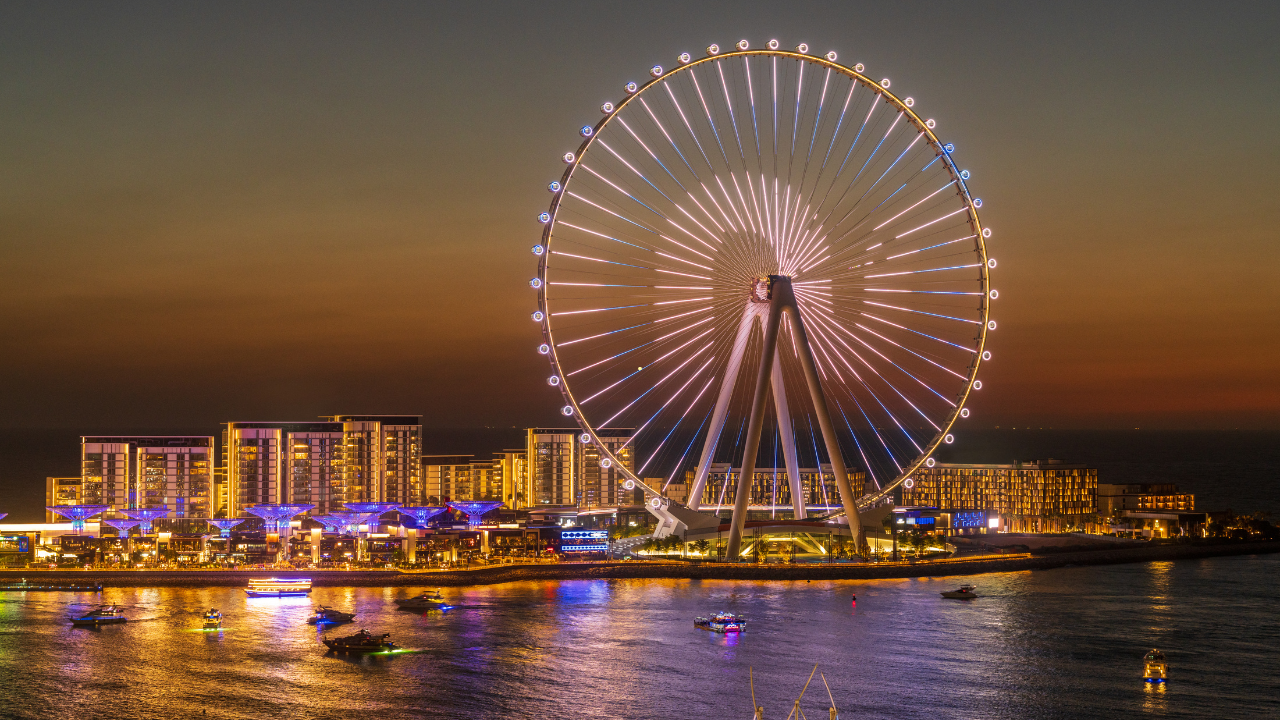
Dubai has hit the pause button on its billion-dollar entertainment machine. If you are planning to visit Global Village, Ain Dubai, Dubai Parks and Resorts, or Wild Wadi Waterpark this weekend, March 7 and 8, 2026, you will find the gates locked. While most weekend guides offer a surface-level list of what is closed, the reality is far more complex than a simple "precautionary measure." This is a city-wide operational pivot driven by a volatile regional security climate that has forced the UAE's National Emergency Crisis and Disaster Management Authority (NCEMA) to prioritize safety over tourism revenue.
The closures are not a response to a direct threat against a roller coaster or a Ferris wheel. Instead, they represent a strategic withdrawal from high-density public gatherings as regional tensions involving Iran, Israel, and the United States reach a fever pitch. In a city where the "show must go on" is the unofficial creed, the decision to shutter the world’s largest observation wheel and its most popular cultural fair is a loud signal of how seriously the authorities are taking current airspace and security developments.
The Shutdown Map
The list of affected venues reads like a "who’s who" of Middle Eastern tourism. The following sites have confirmed they will remain dark through at least Sunday night:
- Global Village: The Season 30 celebrations have been halted. This is particularly significant given that the venue was scheduled to run until May 10, 2026.
- Ain Dubai: The Bluewaters Island landmark is once again stationary.
- Dubai Parks and Resorts: This includes Legoland, Motiongate, and Real Madrid World.
- Wild Wadi Waterpark: The Jumeirah staple has suspended all operations.
- Dubai Festival City: While the mall remains open, the Ramadan drone shows have been postponed indefinitely.
This is not a localized glitch. It is a calculated move to reduce the "soft target" profile of the city during a window of heightened military readiness across the Gulf.
Why the "Precautionary" Label Matters
In the world of high-stakes diplomacy and tourism, words are chosen with surgical precision. By labeling these closures "precautionary," the UAE government is attempting to balance two conflicting goals: maintaining public safety and preventing a total collapse of investor confidence.
Industry analysts know that closing Global Village on a weekend—a period that typically sees hundreds of thousands of visitors—results in a massive revenue hemorrhage for vendors and pavilions. The fact that the closure has been extended multiple times since March 1 suggests that the intelligence informing these decisions is not showing a quick de-escalation.
Security experts point to the recent interception of drones and missiles in the region as the primary catalyst. When the sky is no longer a guaranteed vacuum of peace, operating a 250-meter-high observation wheel or a sprawling theme park becomes a liability that no amount of insurance can cover.
The Economic Aftershock
The timing could not be worse. March is peak season for Dubai, a month where the weather is tolerable and the city is usually flush with international tourists. The cancellation of major events, like the Affiliate World Global conference originally set for the Dubai World Trade Centre, further complicates the narrative.
For the hospitality sector, these closures create a domino effect. Hotels in the Al Barsha and Dubailand areas, which rely heavily on proximity to the Miracle Garden and Global Village, are seeing a spike in cancellations. While Dubai Miracle Garden is currently projected to stay open until June 15, any further escalation in the regional conflict could see its 150 million flowers blooming for an empty audience.
A Split Reality
Curiously, the city is not in a total lockdown. This is the "Dubai Paradox." While the massive theme parks are shuttered, the shopping malls—Dubai Mall, Mall of the Emirates, and Dubai Festival City Mall—remain fully operational.
This creates a strange tension for the average visitor. You can spend $10,000 on a watch at a boutique, but you cannot take your children to see a Lego dragon. This selective shutdown suggests that authorities are focusing on venues where evacuation is complex or where the concentration of people in open-air spaces makes them more vulnerable to regional debris or rapid security shifts.
What This Means for Your Tickets
If you are holding a ticket for a closed attraction, do not expect an immediate cash refund. Most operators, including Dubai Parks and Resorts, are currently pushing for "rebooking" or "credit" options.
- Digital Holders: Check your email immediately. Automated systems are currently processing validity extensions.
- Third-Party Bookings: If you booked through a travel agent or a site like Rayna Tours or Klook, the burden of proof is on you. Reach out now, as their support lines are currently overwhelmed by the March 7 shutdown.
- The "Wait and See" Trap: Do not head to the venue hoping for a last-minute reopening. NCEMA has been explicit: stay away from these areas to allow security protocols to remain unencumbered.
The authorities have also issued a stern warning against "crisis tourism." There have been reports of individuals stopping their cars on highways or heading to the coast to film potential aerial activity. In the UAE, this isn't just dangerous—it is a legal liability. The message is clear: the attractions are closed so that you stay home.
The Horizon for Outdoor Attractions
Looking ahead, the "seasonal" closures of Dubai’s outdoor staples are fast approaching, regardless of the security situation.
| Attraction | Estimated Seasonal Closing 2026 |
|---|---|
| Global Village | May 10, 2026 |
| Ripe Market | May 11, 2026 |
| Dubai Safari Park | June 1, 2026 |
| Dubai Miracle Garden | June 15, 2026 |
If the current geopolitical "precautionary" closures bleed into April, there is a very real possibility that some of these venues may simply not reopen until the next season in October. For an industry built on the promise of 365 days of sunshine and safety, this is a moment of profound reckoning.
The infrastructure of Dubai is designed to withstand many things, from extreme heat to global financial shifts. But as the 2026 Gulf crisis deepens, the city is finding that even the most advanced entertainment hubs are at the mercy of a map they cannot control.
If you need a real-time status update on a specific booking or want to know which indoor alternatives are currently vetted as safe by local authorities, I can monitor the latest government circulars for you.


