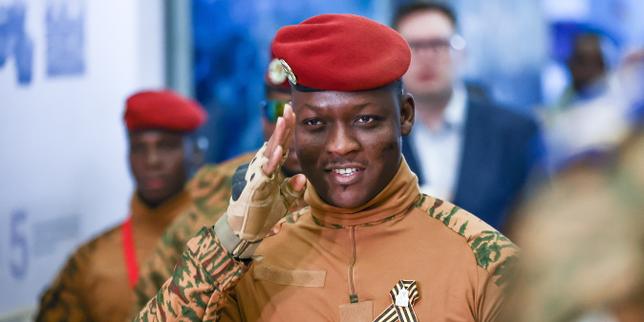
Ibrahim Traoré is no longer just a soldier; he is a symbol of a West African shift that has left the international community scrambling for a coherent response. Since seizing power in September 2022, the world’s youngest head of state has transformed Burkina Faso from a struggling democracy into a laboratory for a specific brand of populist, military-led nationalism. This is not a simple story of a "messy" revolution. It is a calculated, often violent restructuring of a state that felt abandoned by its former colonial masters and failed by its own political elite. The survival of his regime depends entirely on whether his "Volunteers for the Defense of the Homeland" (VDP) can actually reclaim territory from jihadist groups—a task that remains elusive despite the fiery rhetoric coming from Ouagadougou.
The Sovereignist Gambit
Traoré’s rise to power was fueled by a deep-seated resentment toward France. For decades, the presence of French troops under Operation Barkhane was sold as a security necessity. To the young officers in the Burkinabè army, it looked like a permanent occupation that failed to stop the spread of Al-Qaeda and Islamic State affiliates. When Traoré took over, he didn't just ask the French to leave; he burned the bridge.
This wasn't merely a diplomatic spat. It was a strategic pivot toward Russia and the formation of the Alliance of Sahel States (AES) with Mali and Niger. By cutting ties with the Economic Community of West African States (ECOWAS), Traoré bet the house on the idea that "African solutions for African problems" could be financed by shifting allegiances to the Kremlin. The Wagner Group, now rebranded as the Africa Corps, provides a different kind of support—one that doesn't come with lectures on human rights or democratic transitions.
However, the cost of this sovereignty is isolation. Burkina Faso is currently navigating a precarious financial path. Without the budget support typically provided by Western partners and the World Bank, the junta has turned to "patriotic contributions." This is essentially a war tax levied on a population that was already among the poorest on earth. It is a high-stakes gamble. If the security situation improves, the people may tolerate the empty bellies. If the front lines continue to collapse, the patriotic fervor will inevitably sour.
The VDP Experiment and the Price of Civilian Militias
The centerpiece of Traoré’s military strategy is the massive expansion of the VDP. These are civilian volunteers, often given minimal training and a Kalashnikov, sent to hold the line where the regular army cannot. On paper, it is a masterstroke of popular mobilization. In practice, it has blurred the lines between combatants and civilians, leading to a surge in extrajudicial killings and communal violence.
The logic is simple: the regular army is too small to police a territory where nearly 40% of the land is outside government control. By arming the populace, Traoré has essentially outsourced the war. But this has created a cycle of retaliation. When a village forms a VDP unit, it becomes a legitimate target for jihadists. When the jihadists strike back, the VDP and the army often respond with "clearing operations" that human rights organizations have documented as massacres.
The regime’s response to these allegations is consistent: any criticism is a form of treason. Journalists have been kidnapped, activists have been forcibly conscripted into the VDP and sent to the front lines, and the few remaining independent voices in Ouagadougou have been silenced. This is the "hard-hitting" reality of the Traoré era. It is a total war footing where the internal enemy—anyone questioning the junta's effectiveness—is treated with the same severity as the insurgents in the bush.
The Russian Connection and the Security Vacuum
The arrival of Russian instructors and hardware was supposed to be the "silver bullet" for the insurgency. The reality is more nuanced. While Russian drones and helicopters have provided the Burkinabè air force with new capabilities, the ground war remains a meat grinder. The insurgency is not a conventional army; it is a ghost. It moves through the shadows, controls the trade routes, and taxes the gold mines.
The shift away from Western intelligence sharing has created blind spots. While Traoré boasts of new equipment, the fundamental issue of "territorial integrity" remains unsolved. Major towns in the north and east, such as Djibo, have been under blockade for months. Convoys carrying food and medicine require massive military escorts, and even then, they are frequently ambushed. The Russian presence is a political shield against international pressure, but it has yet to prove itself as a decisive military advantage on the scale Traoré promised during his first days in the presidential palace.
A Republic of Fear and Fervor
To understand why Traoré remains popular despite the lack of clear military victories, one must look at his communication. He speaks the language of Thomas Sankara, the iconic revolutionary leader assassinated in 1987. He wears the red beret, he lives modestly, and he speaks directly to the "street." For the youth in Ouagadougou, he is the first leader who looks and sounds like them.
This populist appeal is reinforced by a sophisticated social media apparatus. Pro-junta influencers drown out dissent, labeling any critic as a "valet of imperialism." This creates a feedback loop where the government only hears what it wants to hear. This is dangerous for any leader, but especially for one who came to power via a coup within a coup. The history of Burkina Faso is a history of the military eating its own. Traoré knows this better than anyone, which explains his obsession with internal security and the frequent reports of foiled counter-coups.
The economic reality is the silent killer of revolutions. Burkina Faso's debt is mounting. The gold mines—the country's primary source of foreign currency—are increasingly insecure or being operated under "special arrangements" that do not always benefit the national treasury. Inflation is stinging. While the urban elite might cheer for the departure of the French, the rural farmer is more concerned with the price of fertilizer and the fact that he cannot plant his crops because of the IEDs in his fields.
The Erosion of the Social Contract
The original social contract in Burkina Faso was built on a fragile consensus between various ethnic groups and a tradition of religious tolerance. The current conflict is tearing this apart. The insurgency has successfully exploited grievances among the Fulani (Peul) community, who often feel marginalized by the central state. In response, the mobilization of predominantly Mossi VDP units has taken on an ethnic dimension that threatens the very fabric of the nation.
Traoré’s "revolution" is an attempt to forge a new national identity through struggle. It is a "blood and soil" nationalism that leaves little room for the complexities of a multi-ethnic state. By framing the conflict in purely binary terms—patriots vs. terrorists—the regime is ignoring the socio-economic roots of the insurgency. You cannot kill an idea with a drone, especially if that idea is rooted in a sense of injustice and exclusion.
The international community's response has been largely ineffective. Sanctions from ECOWAS were eventually lifted because they were hurting the people more than the junta. The European Union is paralyzed, torn between a desire to maintain some influence and the need to uphold its values regarding human rights. Meanwhile, Traoré is moving forward with his plan to rewrite the constitution, likely removing term limits and further cementing military rule.
The Inevitable Pivot Point
Burkina Faso is at a crossroads that will determine the stability of the entire West African region. If Traoré succeeds in stabilizing the country and reclaiming the territory, he will become the blueprint for a new generation of African strongmen. If he fails, the resulting vacuum could turn Burkina Faso into a failed state, providing a permanent sanctuary for jihadist groups to launch attacks into neighboring coastal states like Ghana, Togo, and Côte d'Ivoire.
The "camarade président" has tied his personal destiny to the outcome of a war that has confounded some of the most powerful militaries in the world. He has dismantled the old structures of power, but the new ones he is building are fragile and dependent on the charisma of a single man. History shows that when a revolution is built on the personality of a leader rather than the strength of institutions, it rarely survives the first major setback.
The immediate concern is the upcoming harvest season. If the military cannot secure the rural areas, the resulting food insecurity will do more to destabilize the regime than any foreign intervention ever could. Hunger is the one thing that can break the spell of even the most potent populist rhetoric.
Watch the borders, not the headlines. The movement of refugees into the coastal states and the frequency of IED attacks on the main supply routes tell a story that the official communiqués from Ouagadougou try to hide. The revolution is televised, it is tweeted, and it is loud—but on the ground, it is a desperate, quiet struggle for survival. Traoré has the guns and the microphone for now. Whether he has the solution to a decade-long insurgency is a question that will be answered in the dust of the Sahel, far away from the cheering crowds of the capital.