Scientists at Wakehurst, the wild botanic garden in Sussex managed by the Royal Botanic Gardens, Kew, are currently executing a massive ecological experiment to solve a math problem that has haunted conservationists for years. The math is simple and terrifying. We need more bees to pollinate our food, but the UK has lost 97 percent of its wildflower meadows since the 1930s. Without the habitat, the insects vanish. Without the insects, the ecosystem collapses.
The project, often described as a pioneering effort to boost bee numbers, is less about "saving the bees" in a sentimental sense and more about re-engineering the British countryside with surgical precision. By using advanced drone mapping and sensory tracking, researchers are trying to determine exactly how many flowers a landscape needs to support specific pollinator populations. This is the first time a site has been treated as a living laboratory to create a blueprint for the rest of the country.
Beyond the Green Façade
Most people look at a field of grass and see nature. An investigative eye sees a green desert. Modern industrial farming and manicured lawns have stripped the nutrients out of the soil and replaced botanical diversity with monocultures. Wakehurst is attempting to reverse this by turning 500 acres into a high-stakes data set.
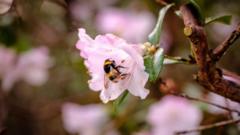
The core of the initiative involves the Millennium Seed Bank. While the bank is famous for being a "doomsday" vault for plant life, its role here is practical and immediate. They aren't just storing seeds; they are deploying them. Researchers are testing different "seed mixes" to see which combinations of wildflowers produce the highest quality nectar. It turns out that not all flowers are equal. Some are junk food for bees—high in sugar but low in the essential proteins needed for larvae to thrive.
This isn't just gardening. It is chemistry.
The Drone Eye View
The most significant shift in this study is the move away from manual counting. Traditionally, a tired grad student would sit in a field with a clipboard and count every bee that landed on a clover. It was slow, prone to human error, and geographically limited.
Now, Wakehurst uses drones equipped with multispectral sensors. These machines fly over the meadows, mapping the density of blooms with a level of detail invisible to the human eye. They can identify the "nectar sugar mass" of an entire field from the air. By overlaying this map with the movement patterns of bees tagged with tiny electronic trackers, scientists can see the "energy highway" the insects use.
They found that bees are remarkably efficient, almost like algorithmic delivery drivers. They calculate the energy cost of flying to a distant flower versus the caloric reward of the nectar inside. If the math doesn't work, the bee stays home or the colony starves. Wakehurst is trying to shorten those routes.
The Hidden Conflict of Competition
One factor often ignored in upbeat press releases is the competition between honeybees and wild bumblebees. Most "save the bees" campaigns focus on the honeybee, which is actually a managed livestock animal. In many ways, the honeybee is the cow of the insect world.
When a hobbyist beekeeper puts a hive in a park, those 50,000 honeybees can strip a meadow of nectar in hours, leaving nothing for the solitary bees or rare bumblebees that actually belong there. The Wakehurst study is one of the few looking at this friction. They are measuring the "carrying capacity" of the land.
How many bees can a hectare truly support?
If we ignore this, we risk "saving" the honeybee while accidentally driving wilder, more efficient pollinators into extinction. The Sussex data suggests that simply planting flowers isn't enough; you have to manage the competition for those resources.
The Problem with Short Term Thinking
Conservation often suffers from the "photo op" effect. A corporation pays to plant a wildflower strip, takes a picture, and then walks away. Within three years, that strip is usually overrun by aggressive grasses or weeds because the soil wasn't prepared or the maintenance budget vanished.
Wakehurst is different because it is a long-term longitudinal study. They are looking at how these meadows evolve over a decade. They are finding that the "yellow rattle" plant, often called the "meadow maker," is the secret weapon. It is a parasite that latches onto the roots of grass, weakening it and allowing delicate wildflowers to find a foothold. Without these biological interventions, the grass always wins.
Replicating the Sussex Model
The ultimate goal of the research isn't just to make Sussex look beautiful. It is to create a "prescription" for landowners across the UK.
Imagine a farmer who wants to access government subsidies for environmental stewardship. Instead of guessing which flowers to plant, they could receive a data-driven kit tailored to their specific soil type, altitude, and local bee species. The Wakehurst team is currently distilling their findings into these practical applications.
They are also looking at the impact of the "hunger gap." This is the period in early spring or late autumn when very few things are in bloom. If a bee wakes up from hibernation and there are no flowers, it dies. The study emphasizes the need for "scaffolding" species—plants like willow or gorse that provide food during these critical windows.
The Financial Reality of Biodiversity
We have to talk about the money. Biodiversity is usually treated as an externality in business, something that doesn't show up on a balance sheet. However, the UK's pollination services are valued at hundreds of millions of pounds annually.
If the Wakehurst study can prove that specific meadow management increases crop yields in neighboring farms, the conversation shifts from "charity" to "infrastructure." This is the pivot that conservationists have been waiting for. We are moving from protecting nature because it is pretty to protecting it because it is a functional component of our economic survival.
The Carbon Sequestration Myth
There is a growing trend of claiming that meadows are as good as forests for carbon capture. The Wakehurst researchers are careful here. While meadows do store carbon in their deep root systems, their primary value is biological, not atmospheric.
Focusing solely on carbon often leads to planting the wrong things in the wrong places. You don't want to plant a forest on a rare ancient grassland. The Sussex study reinforces the idea that we need a mosaic of habitats, each serving a specific purpose. A meadow is a factory for life, and trying to turn it into a carbon offset project can sometimes undermine its primary function.
Sensory Ecology and the Future
Looking forward, the team is experimenting with "acoustic monitoring." Every insect species has a specific vibration or "buzz" frequency. By placing sensitive microphones throughout the gardens, the researchers can track the presence of rare species without ever having to catch them.
This data, combined with the drone imagery, creates a digital twin of the physical landscape. It allows scientists to run simulations. What happens if the temperature rises by two degrees? What happens if we have a drought in June? By testing these variables in the Sussex laboratory, we can predict the failures of the future before they happen on a national scale.
The Immediate Mandate
The work at Wakehurst reveals that our previous efforts at conservation were too small and too disorganized. We cannot fix a systemic collapse with a few "bee hotels" and a packet of seeds from the supermarket.
The mandate now is for large-scale, data-backed restoration. This means changing how we manage roadside verges, how we tax farmland, and how we design our urban spaces. The bees aren't just asking for flowers; they are asking for a connected, high-quality landscape that allows them to move and survive in a changing climate.
Stop thinking about your garden as a private space. Start thinking about it as a single node in a national power grid of biodiversity. Every square meter of turf you replace with a native bloom is a literal life support system for a creature that keeps your food supply chain from snapping.