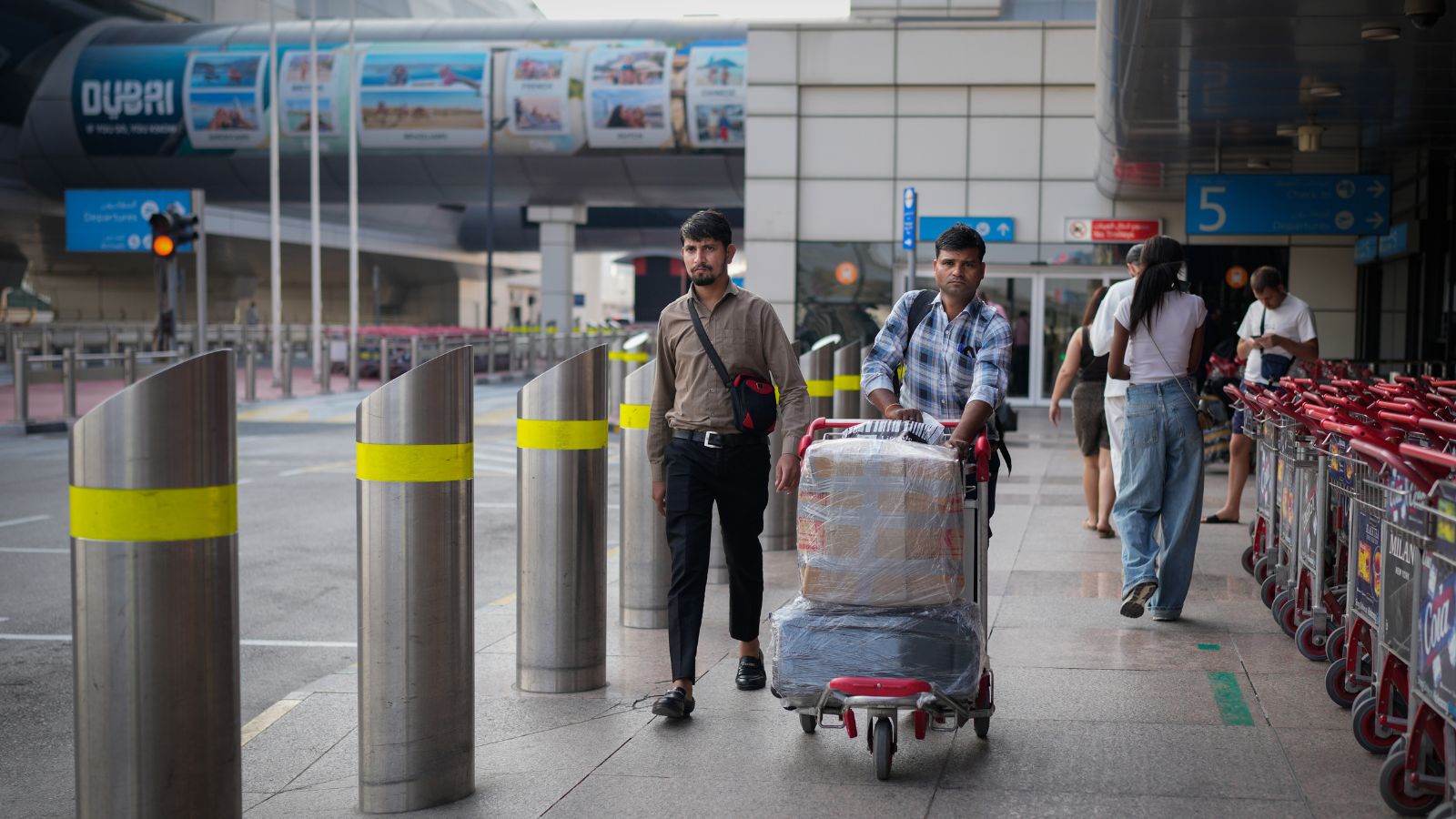
Dubai functions as the primary pressure valve for global long-haul aviation, with Dubai International (DXB) operating as a high-density nodal point connecting the Eastern and Western hemispheres. When geopolitical friction between Iran and Israel escalates, this node does not simply "face delays"; it undergoes a systemic reconfiguration of its risk-to-capacity ratio. Understanding the impact on tourists requires moving past surface-level "travel advisories" and analyzing the three foundational pillars of aviation stability: Airspace Sovereignty, Fuel-to-Payload Economics, and Ground-side Operational Buffer.
The Geometry of Disruption: Airspace Re-Routing
Modern commercial flight paths are not fixed tracks but optimized vectors determined by the Great Circle route, weather, and geopolitical accessibility. The current conflict creates a geographic bottleneck because the Persian Gulf is flanked by Iranian airspace to the north and Saudi/Yemeni airspace constraints to the south.
When the Iranian Flight Information Region (FIR) becomes a high-risk zone or is closed, the "Anatomy of the Detour" takes effect. Airplanes cannot simply turn left; they must navigate through specific entry and exit points known as waypoints.
- The Narrowing Corridor: Traffic is diverted into the "KOLOK" or "LUKAR" corridors through Iraq or Saudi Arabia. This creates a vertical stacking problem. As more planes are funneled into a narrower strip of sky, Air Traffic Control (ATC) must increase the longitudinal separation between aircraft.
- The Velocity Penalty: Increased separation results in "flow control" at the departure gate. A flight from London to Dubai might sit on the tarmac for 90 minutes not because of a mechanical failure, but because the "slot" in the safe corridor over Turkey or Iraq is occupied.
The Cost Function of Rerouting: Weight and Balance
Aviation is a business of margins, and those margins are governed by the Breguet Range Equation. For every extra mile flown to avoid a conflict zone, a cascade of technical compromises occurs.
- Fuel Over-provisioning: If a flight must bypass Iranian airspace by flying further south over the Arabian Peninsula, it adds 45 to 90 minutes of flight time. A Boeing 777-300ER burns roughly 7,000 to 8,000 kilograms of fuel per hour.
- The Payload Trade-off: Aircraft have a Maximum Take-Off Weight (MTOW). If the airline must load an extra 10 tons of "contingency fuel" to account for potential holding patterns or longer routes, that weight must come from somewhere. On ultra-long-haul flights (e.g., Los Angeles to Dubai), this often results in "payload capping," where the airline intentionally leaves seats empty or refuses cargo to keep the plane light enough to take off with the extra fuel required for the detour.
For the tourist, this manifests as higher ticket prices (reflecting the increased fuel burn) and a higher probability of being bumped from overbooked flights where weight limits have suddenly become more restrictive.
The Operational Buffer: Hotel and Ground Capacity
Dubai’s hospitality sector is calibrated for "high-velocity throughput." The system assumes that 90% of guests checking out at 11:00 AM will be replaced by guests arriving by 6:00 PM. Geopolitical instability breaks this "Just-in-Time" inventory model.
The Stranded Load Factor
When a major airline like Emirates or flydubai cancels a wave of flights due to airspace closures, they suddenly have 20,000+ passengers who require accommodation. This creates an immediate "supply shock" in the local hotel market.
- The Buffer Depletion: Economy-tier hotels near DXB and DWC (Al Maktoum International) are the first to hit 100% occupancy as airlines move their "distressed passengers" into these rooms.
- The Rate Spike: If you are a tourist arriving independently during a crisis, you are competing for the remaining 5% of "uncommitted" rooms against airline procurement teams with corporate credit lines.
Insurance and Force Majeure
A critical distinction often missed is the trigger for "Force Majeure." If an airline cancels a flight because an airport is physically bombed, that is a clear-cut case. However, if an airline cancels a flight as a proactive safety measure due to "heightened tension," the legal obligation for compensation changes. Under many international conventions, "Extraordinary Circumstances" (Article 5, Paragraph 3 of EC 261/2004) may exempt the airline from paying cash compensation, though they remain responsible for the "Duty of Care" (food and lodging).
Navigational Logic for the Strategic Traveler
To mitigate the risks of a Persian Gulf transit during periods of kinetic conflict, one must utilize a hierarchy of logistical safeguards.
1. Carrier Selection based on Hub Proximity
If you are flying from Europe to Asia, a "Middle East Hub" (Dubai, Doha, Abu Dhabi) is geographically vulnerable because your transit point is within the potential strike radius or the immediate detour zone. Choosing a "Circumferential Hub" (Singapore, Istanbul, or London) provides a safety buffer. If the Persian Gulf airspace closes, an Istanbul-based carrier can route north over Central Asia more efficiently than a Dubai-based carrier can route south.
2. The PNR (Passenger Name Record) Integrity
In a mass-cancellation event, the airline’s rebooking algorithm prioritizes passengers based on their PNR status.
- Direct Bookings: Passengers who booked directly with the airline are at the top of the "automation queue."
- OTA Lag: Those who booked via third-party Online Travel Agencies (OTAs) often face a "Data Handshake" delay. The airline tells the OTA the flight is canceled; the OTA must then process this before the passenger can be rebooked. In a crisis, a 4-hour delay in this handshake can be the difference between getting the last seat on tomorrow's flight or waiting three days.
3. Redundant Communication Channels
During the April 2024 escalations, phone lines for major carriers reached 6-hour wait times. The mechanism for rapid resolution is rarely the call center.
- The Desktop vs. App Mismatch: Airline apps are often "cached," meaning they might show a flight as "On Time" when the internal operations system has already flagged it as "Canceled." Always verify the tail number's current position using independent ADS-B tracking software. If the incoming aircraft hasn't left its origin, your departure is mathematically impossible regardless of what the airport screens say.
Infrastructure Resilience: The Iron Dome of Logistics
Dubai’s response to regional instability is not just diplomatic; it is structural. The city utilizes a "Multi-Airport Strategy." If DXB becomes congested or faces a safety-related slowdown, cargo and low-cost carrier operations are shifted to DWC. This "Flex-Capacity" allows the city to keep the primary runways open for high-priority international transits.
Furthermore, the UAE maintains one of the world’s most sophisticated integrated air defense systems. For the traveler, this means that the "physical risk" to the airport itself is statistically lower than the "logistical risk" of your flight being rerouted to a third-country airport like Muscat or Riyadh due to a sudden closure of the Iraqi-Jordanian corridor.
Strategic Forecast: The Shift to "Long-Haul Avoidance"
As long as the Iran-Israel friction remains a "simmering conflict" rather than a total war, Dubai will remain the global pivot point. However, we are seeing the emergence of a "Bypass Economy." Carriers are increasingly looking at ultra-long-range aircraft like the Airbus A350-1000 to fly routes that completely avoid the Middle Eastern "Corridor of Uncertainty."
For the individual traveler, the immediate tactical play is a shift toward "Flex-Scheduling." The era of the "tight 2-hour connection" in Dubai is over for anyone without a high tolerance for risk. The new standard for resilient travel is a minimum 5-hour transit window, providing the necessary buffer for the inevitable flow-control delays that now define the region's airspace.
Verify the specific "Conflict Zone" insurance rider on your policy. Most standard travel insurance policies include an "Act of War" exclusion clause. If a trip is canceled because the government issues a "Do Not Travel" advisory, you are generally covered. If you cancel because you feel "unsafe" but no advisory has been issued, you will absorb 100% of the loss. Monitor the "Notice to Airmen" (NOTAM) filings for the OMAE (UAE) and OIIX (Iran) flight information regions; these are the primary legal documents that dictate where planes can and cannot fly, preceding any media reports by several hours.