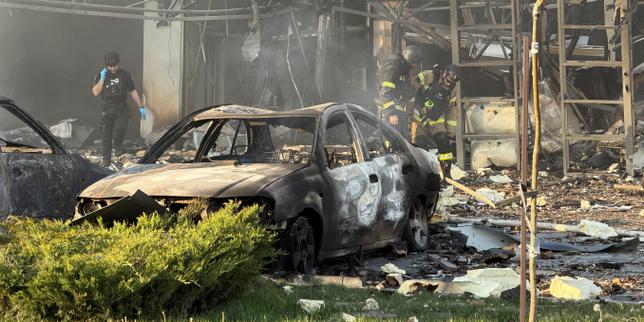
The media is addicted to the body count. Every morning, we wake up to a digital tally of the fallen in places like Zaporizhzhia and Kramatorsk. Twelve dead here. Five dead there. The headlines treat these tragedies as a scoreboard, suggesting that the side with the higher number of casualties or the more heart-wrenching footage is somehow "losing" or "winning" a war of attrition.
This is a fundamental misunderstanding of modern high-intensity conflict. We are witnessing the "reporting of the tactical" to mask a total lack of understanding regarding the "operational."
War is not a spreadsheet of human suffering. If you think a strike on a residential building in Zaporizhzhia changes the strategic calculus of the 2026 spring offensive, you are looking at the wrong map. These incidents, while horrific, are symptoms of a much larger, colder logistical reality that the talking heads refuse to touch because it doesn't get clicks.
The Body Count Fallacy
Since the Vietnam era, the West has been obsessed with body counts as a metric of success. It was a failure of logic then, and it is a failure now. In the current conflict in Ukraine, focusing on the number of civilians killed in a missile strike—while morally necessary for the record—is strategically irrelevant to the outcome of the war.
Modern warfare is a contest of industrial throughput. It is about who can produce more 155mm shells, who can field more electronic warfare (EW) suites, and who can sustain a power grid under constant pressure. When we lead with "12 dead in Zaporizhzhia," we shift the focus from the fact that the interceptor missiles used to defend that city are being depleted at a rate that the domestic defense industry cannot match.
The tragedy isn't just the lives lost today; it’s the systematic exhaustion of the defensive umbrella. By focusing on the blood on the pavement, we ignore the empty warehouses behind the front lines.
The Precision Paradox
Common wisdom suggests that Russian forces are "running out" of precision weapons, hence the strikes on civilian infrastructure. This has been the refrain for over three years. It was wrong in 2022, and it is wrong now.
What we are actually seeing is a shift in target priority that reflects a brutal, if cynical, logic. The goal isn't necessarily to kill five people in Kramatorsk. The goal is to force the Ukrainian military to keep high-end air defense systems like the Patriot or IRIS-T tucked into urban centers rather than moving them to the front where they could protect advancing armor.
By hitting soft targets, the aggressor dictates the deployment of the defender's most valuable assets. Every time a S-300 battery is fired to stop a drone over a city, that’s one less missile available to stop a Su-34 from dropping glide bombs on a trench line. The "senselessness" of the violence is the point. It is a resource-drain maneuver.
Why the "Front Line" is an Outdated Concept
The maps you see on news sites with the big red and blue blobs are lying to you. They imply a 1914-style stalemate where movement is the only metric of progress. In reality, the "front line" is now a 50-kilometer deep zone of transparency where nothing larger than a bicycle can move without being spotted by a $500 thermal drone.
We talk about Kramatorsk as a city "near the front." In reality, Kramatorsk is a logistical hub. The strikes there aren't random acts of cruelty; they are attempts to disrupt the "just-in-time" supply chain that keeps the Donbas defense alive.
The status quo reporting suggests that as long as the line doesn't move, the war is a "draw." This is a dangerous delusion. You can hold a line for months while your capacity to wage war is being hollowed out from within. If your railheads are destroyed, your repair shops are smoking ruins, and your specialists are being picked off in their barracks, the line will eventually vanish in a single afternoon.
The Industrial Reality Nobody Wants to Hear
I’ve seen how these procurement cycles work. I’ve seen the sheer panic in boardrooms when it’s realized that a single month of high-intensity combat consumes more microchips than a major manufacturer produces in a year.
The hard truth? The West’s "boutique" defense industry is not built for this. We build Ferraris—exquisite, expensive, and slow to produce. Our opponent builds tractors—crude, plentiful, and easy to replace.
When a missile hits Zaporizhzhia, the immediate response is a call for more "sanctions." This is the ultimate lazy consensus. Sanctions on high-end tech don't stop the production of low-end, effective mass-market weaponry. The "shadow fleet" and third-party intermediaries have rendered the 2024-era sanctions packages largely symbolic.
The Wrong Questions
The public is asking: "When will the war end?"
The wrong question.
The real question is: "What is the current rate of barrel wear on Ukrainian artillery versus the delivery schedule of replacements?"
The public asks: "How can we stop these strikes on civilians?"
The honest, brutal answer: You can't, unless you achieve total air superiority, which is impossible without a direct intervention that no one is willing to execute.
Dismantling the Victim Narrative
There is a tendency in reporting to treat the Ukrainian military as a passive recipient of blows—a victim waiting for help. This is an insult to their agency. They are currently conducting the most sophisticated drone-integrated defense in human history.
But when the media focuses purely on the tragedy of the strikes in the rear, they miss the terrifyingly effective innovations happening at the edge. They miss the fact that the war is being won or lost in the electromagnetic spectrum, not in the rubble of a Kramatorsk apartment building.
If we continue to consume war as a series of isolated tragedies, we remain blind to the structural collapse or structural resilience that actually determines the fate of nations. Stop looking at the body counts. Start looking at the power plants, the transformer stations, and the shell-production quotas.
The headlines give you the "what." They never give you the "so what."
The deaths in Zaporizhzhia are a tragedy. The depletion of the air defense magazine that was supposed to protect them is a catastrophe. Learn to tell the difference.
Stop mourning the tactical and start fearing the operational.