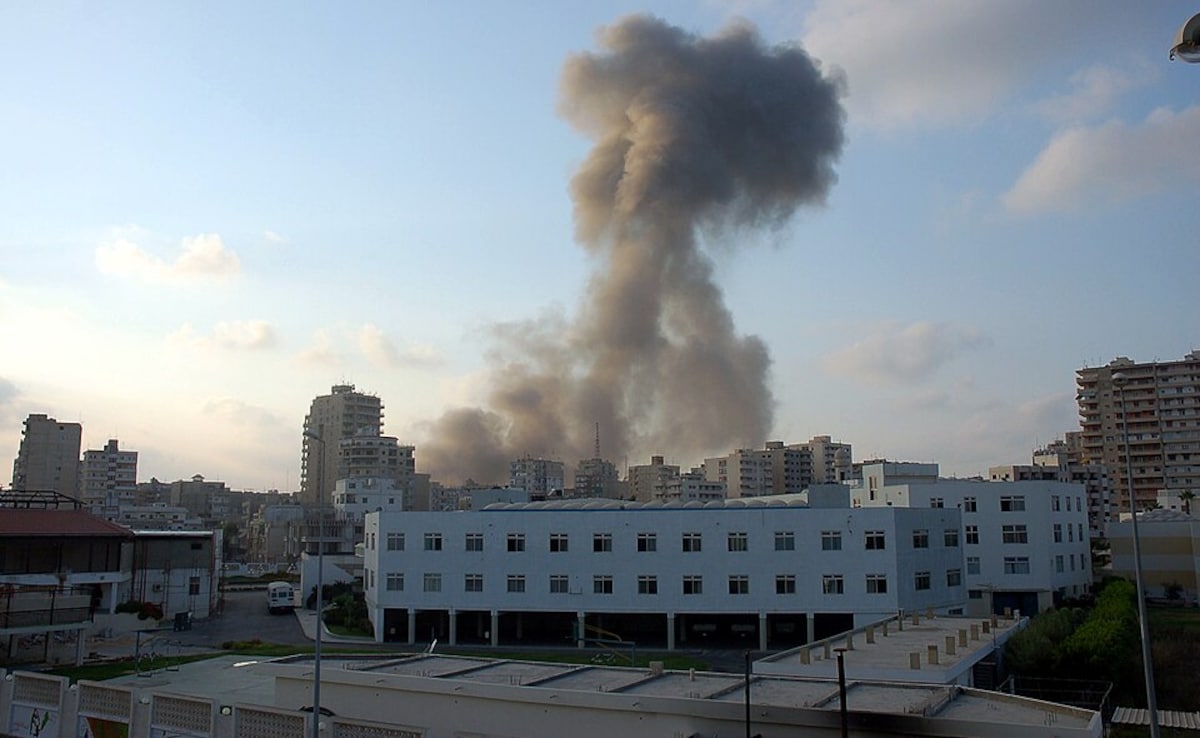
Thirteen dead. That is the number currently being fed into the news cycle following the latest Israeli strikes in Lebanon. The media treats these numbers like a scoreboard. They act as if a tally of bodies provides a clear metric for who is winning or losing. This is the first and most dangerous mistake in war reporting. Body counts are a relic of industrial-age warfare—a "lazy consensus" metric that obscures the actual mechanics of 21st-century conflict.
When you see a headline like "13 Killed," the implication is that a tragedy has occurred, or a tactical blow has been struck. Both may be true, but neither tells you anything about the strategic reality. In a conflict defined by asymmetric capabilities and deep-state proxies, counting the fallen is like trying to understand a chess match by weighing the captured pawns. It’s a category error that ignores the psychological and structural shifts occurring beneath the rubble.
The Body Count Fallacy
For decades, military analysts have fallen into the trap of attrition-based reporting. This obsession dates back to Vietnam, where the U.S. military command used body counts to justify a "winning" trajectory that didn't exist. Today, we see the same pattern. The media focuses on the immediate carnage of an Israeli strike in Nabatieh or Sohmor because it is visceral and easy to count.
But here is the truth: attrition does not win modern wars against non-state actors. It hardens them. When 13 people die in a strike, the immediate Western reflex is to ask if this will deter the adversary. It won't. In the doctrine of groups like Hezbollah, tactical loss is baked into the operating model. They operate on a timeline of decades, not news cycles. If you kill a mid-level commander, three subordinates are already vying for the vacancy. The "kill chain" is a circle, not a line.
The real story isn't the 13 dead. It’s the degradation of the logistics network. It’s the severance of communication lines. It’s the shift in civilian displacement patterns that creates internal political pressure within Lebanon. If the strike destroyed a specific intelligence node or a munitions cache, that matters ten times more than the number of casualties, yet those details are buried under the sensationalism of the morgue report.
The Mirage of "Precision"
We are constantly told that modern strikes are "surgical." This is a comforting lie sold to the public to make war more palatable. There is no such thing as a surgical strike in a densely populated urban environment like Southern Lebanon. When a missile hits a residential building used for military storage, the physics of blast waves doesn't care about your "precision" targeting.
The "precision" narrative serves a dual purpose. For the Israeli Defense Forces (IDF), it validates their technological superiority. For the critics, any deviation from perfection is evidence of a war crime. Both sides are playing a game of optics that ignores the brutal reality of the grey zone.
In the grey zone, the line between combatant and civilian is intentionally blurred. This isn't a "tragedy of war"; it’s a deliberate tactical choice. If an insurgent group stores rockets in a kitchen, they have effectively weaponized the Geneva Convention. They are betting that the political cost of the "13 dead" headline will outweigh the tactical gain of the destroyed rockets. When we report only the death toll, we are participating in that strategy. We are the amplifiers of a psychological operation designed to paralyze decision-making through moral outcry.
The Internal Lebanese Calculus
Stop looking at Lebanon as a monolith. The headlines suggest a nation under fire, but the reality is a fractured state where the "13 dead" are viewed through a dozen different lenses.
- The Hezbollah Base: For them, these are martyrs. Each death is fuel for recruitment.
- The Christian and Sunni Opposition: For many in Beirut, these strikes are the bitter fruit of a conflict they never signed up for. They see the deaths as a direct result of a "state within a state" dragging the country into an Iranian-led regional firestorm.
- The Lebanese Armed Forces (LAF): They sit on the sidelines, funded by the West but powerless to intervene, watching their sovereignty evaporate.
By focusing on the casualty count, the media ignores the shifting internal friction. The real question isn't "How many died?" but "How much closer does this move Lebanon to a total internal collapse?"
The Lebanese economy is already a corpse being moved by strings. A few more weeks of "targeted" strikes that displace another 100,000 people from the south will do more to destroy Lebanon than any direct invasion ever could. The displacement is the weapon. The chaos is the objective. The 13 dead are merely the signal that the machine is still running.
The Myth of De-escalation
Every time a strike happens, the international community calls for "de-escalation." This is the most exhausted phrase in the diplomatic lexicon. It assumes that both parties want to stop.
They don't.
Israel is currently operating under a doctrine of "restoring deterrence." This is a polite way of saying they are willing to burn the neighborhood down to prove they are the toughest kid on the block. Hezbollah, conversely, is committed to a "unity of fronts" strategy. They cannot stop without losing face and abandoning their raison d'être.
When you read about 13 killed, you aren't seeing a "flare-up." You are seeing a calibration. Both sides are testing how far they can push before the threshold of "Total War" is crossed. We are in a permanent state of high-tension calibration. "De-escalation" isn't a goal; it’s a pause to reload.
Why the "People Also Ask" Questions Are Wrong
If you search for this topic, you’ll find questions like "Is it safe to travel to Lebanon?" or "Who started the conflict?"
The first question is naive. Nowhere in the Levant is "safe" in the traditional sense; safety is just a temporary absence of kinetic activity. The second question is a historical trap. Do you start the clock in 2023? 2006? 1982? 1948? Searching for an "instigator" is a playground tactic. In the adult world of geopolitics, there are only interests and capabilities.
Instead of asking who is right, ask who is capable of sustaining the status quo. Israel has the air superiority, but Hezbollah has the "strategic depth" of the Iranian supply line. This isn't a war of right vs. wrong; it’s a war of exhaustion vs. technology.
The Cost of the Wrong Metric
By prioritizing the casualty count, we treat war as a series of isolated incidents rather than a continuous process. We look for a "breaking point" that doesn't exist.
I’ve seen this play out in various conflict zones over the last two decades. You can kill 13 people every day for a year, and if the underlying political grievances and regional power structures remain unchanged, you have achieved nothing but a higher bill for jet fuel and a more radicalized generation of orphans.
The obsession with numbers is a form of intellectual laziness. It allows readers to feel a momentary pang of sympathy or anger without having to understand the brutal, interlocking gears of Middle Eastern power dynamics. It’s "fast food" journalism—high in emotional calories, zero in nutritional insight.
Stop counting the dead and start counting the variables that actually move the needle:
- The price of Iranian crude: That’s what funds the rockets.
- The depth of Israeli bunker-buster stockpiles: That determines the duration of the campaign.
- The silence of the Arab states: That tells you who is secretly rooting for the "surgical" destruction of the proxy network.
The 13 killed in Lebanon are not a statistic. They are a distraction from the reality that the regional order is being rewritten in real-time, and no amount of "precise" bombing is going to bring back the world that existed before the first missile was launched.
War is not a ledger of lives lost. It is a competition of wills. And right now, the will to continue far outweighs the will to count the cost.
If you want to understand the conflict, look past the morgue. Look at the maps. Look at the money. Look at the silence. The numbers are just noise designed to keep you from seeing the machine.