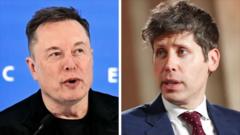
The legal confrontation between Elon Musk and OpenAI executives Sam Altman and Greg Brockman represents more than a personal feud; it is a structural collision between donor-intent philanthropy and venture-scale commercialization. At its core, the trial Musk v. Altman (4:24-cv-04722) examines whether a foundational mission, though not codified in a traditional bilateral contract, constitutes a binding "charitable trust" that prevents a nonprofit from evolving into a for-profit-dominated entity.
The Foundational Architecture: Contract vs. Charitable Trust
The defense’s primary argument hinges on the absence of a signed, formal contract. Under standard contract law, a breach requires a specific, written agreement with defined consideration. OpenAI's defense team, led by Sarah Eddy and William Savitt, has capitalized on this void, asserting that Musk’s contributions—totaling $38 million to $44 million depending on the accounting—were "unrestricted gifts."
Musk’s legal strategy, however, shifts the framework from contract law to equity and charitable trust law. The argument posits that:
- The Inducement: Musk’s capital and reputational endorsement were secured through a specific promise: that OpenAI would remain a non-profit developing Artificial General Intelligence (AGI) for "humanity" rather than proprietary shareholder gain.
- The Specific Purpose: The "Founding Agreement," while expressed in emails and public manifestos rather than a single document, created an irrevocable purpose for the assets.
- The Deviation: The creation of a "capped-profit" subsidiary and the subsequent 2025 formation of OpenAI Group PBC (where the nonprofit holds only a 26% stake while Microsoft holds 27%) represents a total departure from that purpose.
The Credibility Gap: Assessing Altman’s Operational Integrity
A critical component of the trial has been the systematic dismantling of Sam Altman’s credibility. Musk’s lead attorney, Steven Molo, focused on testimony from five high-profile witnesses: Ilya Sutskever, Mira Murati, Helen Toner, Tasha McCauley, and Musk himself. Each witness characterized Altman’s communication style as deceptive or strategically evasive.
The operational significance of these characterizations is not merely moral; it is legal. If Altman is viewed as an unreliable witness, his testimony regarding the "unrestricted" nature of Musk's donations carries less weight. Furthermore, the trial revealed internal communications, such as Altman reaching out to Shivon Zilis in early 2023 for advice on how to manage Musk’s public perception, suggesting a calculated approach to narrative control rather than transparency.
The Economic Bottleneck: The $134 Billion Disgorgement
The financial stakes of the trial are unprecedented in the nonprofit sector. Musk is seeking the removal of Altman and Brockman from the board and a reversal of the for-profit structure. More importantly, he is pursuing a $134 billion disgorgement. This figure is derived from the projected valuation of OpenAI—currently seeking an IPO at a $1 trillion valuation—and represents the value Musk claims was "bilked" from the nonprofit mission.
The judge, Yvonne Gonzalez Rogers, has already signaled the severity of this claim. In a sharp exchange, she forced Musk’s legal team to clarify their position: they are not seeking personal damages for Musk, but rather the redistribution of "ill-gotten" billions back into the charitable arm of OpenAI. This creates a binary outcome:
- A Defense Verdict: Confirms that founders can pivot nonprofit assets into for-profit vehicles as long as no explicit contract forbids it.
- A Plaintiff Verdict: Establishes a precedent that "charitable intent" in tech philanthropy is legally binding, effectively freezing OpenAI’s ability to proceed with its IPO.
The Statute of Limitations Constraint
The most immediate threat to Musk’s case is a procedural one: the statute of limitations. OpenAI argues that Musk was aware of the for-profit pivot as early as 2017/2018 and failed to act until 2024. California law generally provides a short window for alleging breach of trust or unjust enrichment.
The jury must decide if the clock started:
- In 2018: When Musk left the board after his failed bid for control.
- In 2019: When the capped-profit entity was first announced.
- In 2023: When GPT-4 was licensed to Microsoft, which Musk argues was the definitive moment AGI (or near-AGI) was "stolen" from the public.
If the jury finds that Musk "unreasonably delayed" his filing (Laches), the merits of the case become irrelevant, and the court will direct a verdict for the defendants.
The Strategic Recommendation for Market Observers
The outcome of this trial will define the legal boundaries of "Open Source" and "Nonprofit" labels in the AI sector. Organizations should treat the current OpenAI structure as high-risk until a verdict or settlement is reached.
The strategic play for investors and competitors is to prepare for two distinct scenarios:
- If the IPO proceeds: OpenAI will likely face permanent regulatory oversight regarding its "benefit corporation" status, requiring more transparent safety reporting to mitigate the "bad faith" optics raised during this trial.
- If Musk wins: A massive decapitalization event will occur as OpenAI’s assets are forced back into a nonprofit structure, likely triggering a talent exodus to competitors like Anthropic or xAI, and potentially nullifying Microsoft’s exclusive licensing rights to the underlying models.
The final strategic move for the board of OpenAI is no longer a legal one, but an existential one: they must prove that "benefiting humanity" is still functionally possible within a structure where the nonprofit is no longer the majority owner of its own creation.