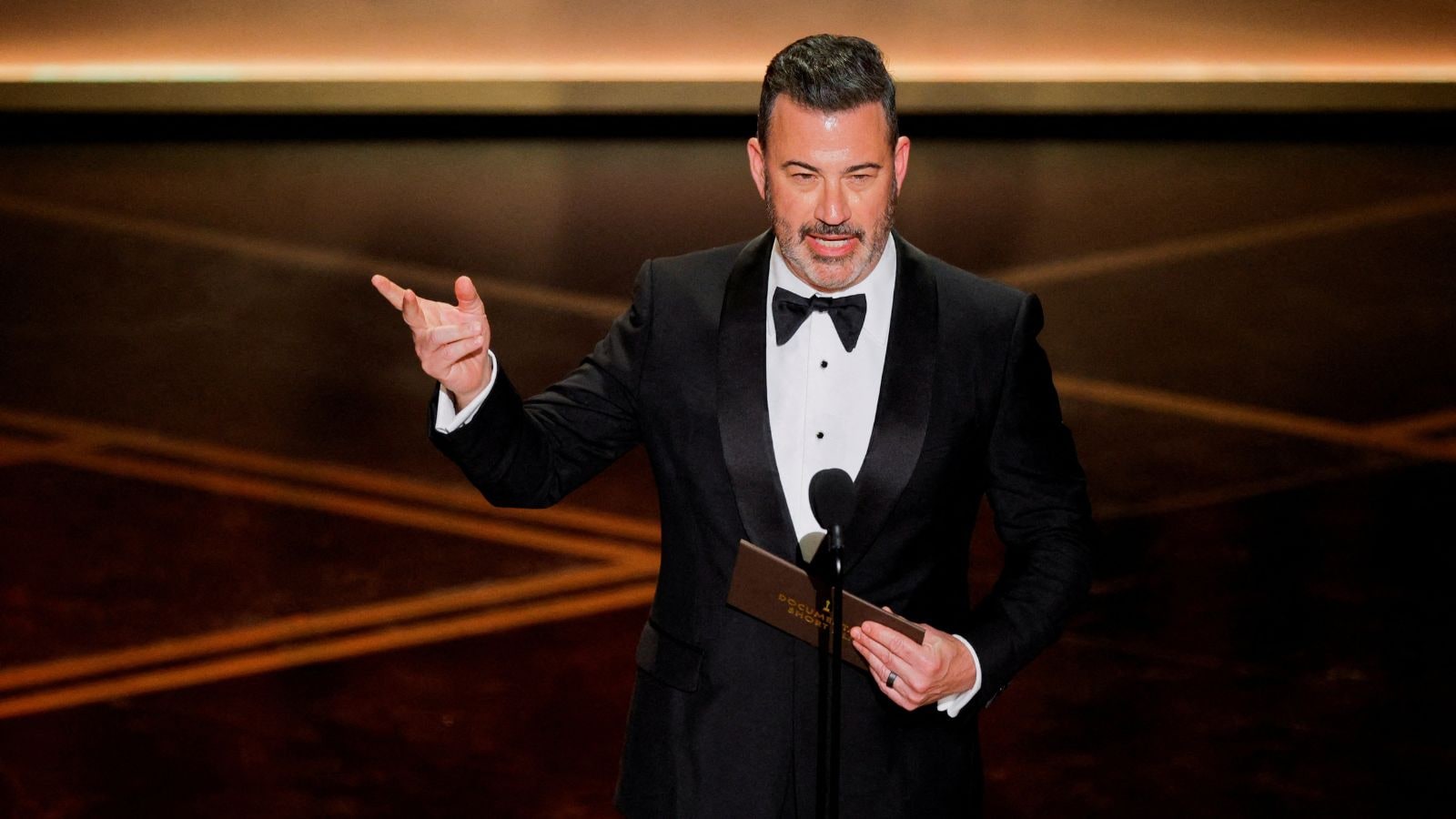
The lights in a television studio aren't just bright. They are heavy. They press down on your shoulders with a physical weight, a heat that smells faintly of ozone and expensive dust. When the red tally light on the camera lens flickers to life, the man standing behind the podium isn't just a comedian anymore. He is a lightning rod.
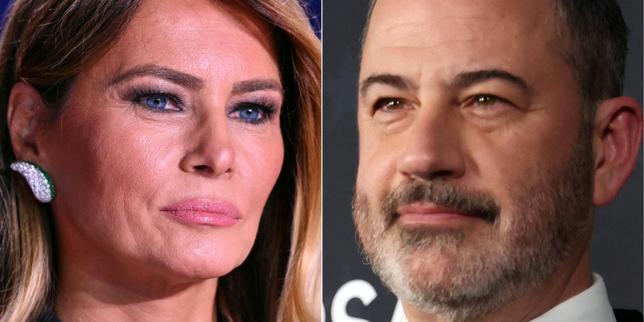
Jimmy Kimmel stood in that heat recently, blinking against the glare of a news cycle that had curdled into something ugly. It started, as these things often do, with a joke. A sharp, perhaps jagged, observation about Melania Trump. Then came the reaction—a tidal wave of digital fury that didn't just call for an apology, but accused him of something far darker: inciting an assassination.
This is where we are now. The distance between a punchline and a federal crime has shrunk to the width of a tweet.
Donald Trump, ever the master of the counter-punch, took to his platform to frame Kimmel’s monologue not as satire, but as a dog whistle for violence. It is a dizzying pivot. One moment, you’re laughing at the absurdity of political pageantry; the next, you’re being accused of treason in the court of public opinion. Kimmel didn’t retreat. He didn’t offer the curated, bloodless PR statement that usually follows these collisions. Instead, he leaned back into the microphone.
He called it "nonsense." Pure, unadulterated nonsense.
Think about the mechanics of a joke for a second. It requires a shared understanding of reality. To laugh, we have to agree on what the floor looks like so we can notice when someone trips over it. But when the floor is ripped up and replaced with a hall of mirrors, the joke stops being a joke. It becomes a weapon. Or, if you’re the one being teased, it becomes an excuse to claim victimhood on a grand, dangerous scale.
The accusation against Kimmel wasn't just a critique of his taste. It was a calculated attempt to redefine the boundaries of speech. If every jab at a public figure’s spouse or every sarcastic remark about a former president can be categorized as a "call to violence," the stage goes dark. The jester is silenced not by the law, but by the sheer exhaustion of having to defend his soul every Tuesday night.
Consider the hypothetical viewer sitting at home in a quiet suburb. Let’s call him Elias. Elias has had a long day. He wants to watch a man in a suit make fun of the people who make his life complicated. When he hears the joke about Melania, he smiles. It’s a release valve. But then he opens his phone and sees the headline: Kimmel Accused of Inciting Murder. Suddenly, Elias feels a cold shiver. Was he wrong to laugh? Is he now an accomplice to something sinister? This is the invisible stake of the "Melania joke row." It’s not just about two famous men yelling at each other across a digital divide. It’s about the slow, methodical poisoning of our ability to recognize humor.
Kimmel’s defense was grounded in a desperate kind of logic. He pointed out the absurdity of the leap. He walked the audience through the literal words he used, stripping away the hyperbole of his detractors. He was, in effect, teaching a masterclass in reading comprehension while the building was supposedly on fire.
The reality is that we are living through a period of hyper-literalism. We have lost the capacity for metaphor. When a comedian says he wants to "kill" on stage, we used to know he meant he wanted the audience to laugh until their ribs ached. Now, there is a vocal segment of the population waiting with a notepad and a lawyer, ready to interpret every syllable as a literal directive.
It’s exhausting.
The friction between the comedian and the politician is as old as the republic, but the stakes have shifted. In the past, a president might have grumbled about a caricature in the newspaper. Today, that president has the power to mobilize a digital militia that treats words like physical strikes. Kimmel isn't just fighting for his right to tell a joke; he's fighting for the right to exist in a space where everything isn't a high-stakes battle for survival.
He looked into the camera—that unblinking, glass eye—and told the truth. He reminded everyone that a joke is a joke, even when it’s directed at someone powerful. Especially then. If we lose the ability to poke at the armor of the elite without being accused of wanting to pierce their skin, we have lost the very thing that keeps the power balanced.
The air in that studio stayed hot. The audience laughed, but the laughter had a jagged edge to it. It was the sound of people realizing that the floor under their feet was still shifting. Kimmel finished his monologue, the music swelled, and the screen cut to black.
But the silence that followed wasn't peaceful. It was the heavy, expectant silence of a world waiting for the next accusation to fly, wondering which word would be the one that finally broke the scales for good.