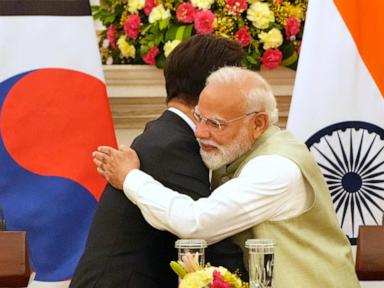
The ambitious roadmap to hit $50 billion in bilateral trade by 2030 represents a desperate necessity for both India and South Korea. While headlines focus on the massive number, the reality on the ground is a lopsided economic relationship that has remained largely stagnant for a decade. India and South Korea have committed to nearly doubling their current trade volume, but the path to that target requires more than just diplomatic handshakes. It demands a complete overhaul of the Comprehensive Economic Partnership Agreement (CEPA) that has historically favored Korean exporters while leaving Indian manufacturers struggling to find a foothold in Seoul.
The current trade figure hovers around $27 billion. Moving to $50 billion in less than six years is a steep climb, particularly when you consider that the trade deficit heavily skews against India. New Delhi is no longer content with being a passive consumer of Korean electronics and automobiles. The Indian government is pushing for "reciprocity," a word that carries significant weight in the backrooms of the Ministry of Commerce and Industry.
The Trade Deficit Trap
The core of the problem lies in the original 2010 CEPA. At the time, it was hailed as a landmark deal. However, Indian officials now view it as a relic that allows Korean goods—specifically high-end electronics and steel—to flood the Indian market with minimal duties, while Indian agricultural and pharmaceutical exports face a wall of non-tariff barriers in South Korea.
South Korea’s regulatory environment is notoriously difficult to penetrate. For an Indian drug manufacturer to get approval from the Ministry of Food and Drug Safety in Seoul, they must jump through hoops that their Korean counterparts in India simply do not face. This imbalance has turned the trade relationship into a one-way street. The $50 billion target is meaningless if $40 billion of that represents a deficit for India.
The numbers don't lie. India’s export basket to South Korea remains dominated by raw materials like aluminum and organic chemicals. Meanwhile, Korea exports high-value machinery and finished goods. This is the classic trap of a developing economy trading with a developed one. To break it, New Delhi is demanding "market access" that isn't just a phrase on a piece of paper but a functional reality for Indian businesses.
Moving Beyond Assembly Lines
Samsung and Hyundai are household names in India. They have invested billions, yet a significant portion of their operations involves assembling components shipped from Korea or China. The Indian government’s "Make in India" initiative is designed to change this. They want these giants to move from assembly to deep manufacturing.
The production-linked incentive (PLI) schemes are the primary tool for this shift. By offering cash incentives for local manufacturing, India is trying to force Korean companies to build their supply chains within Indian borders. It is a high-stakes play. If Korea complies, India gains jobs and technology. If Korea resists, the trade friction will only intensify.
The Semiconductor Frontier
India wants a piece of the global semiconductor pie. South Korea, home to Samsung and SK Hynix, is the undisputed king of memory chips. The discussions in New Delhi have shifted from simple trade to technology transfers. India is positioning itself as a "China Plus One" destination—a secondary hub for global companies looking to diversify their supply chains away from Beijing.
However, Korean firms are cautious. Building a semiconductor fab requires consistent power, massive amounts of water, and a highly specialized workforce. While India has the ambition, the infrastructure is still catching up. The race to 2030 will depend heavily on whether Seoul views India as a true partner or just a secondary market to offload older technology.
The Geopolitical Anchor
Economics is never just about money. The proximity of North Korea and the rising influence of China in the Indo-Pacific have forced Seoul to look toward India as a strategic counterbalance. The "Special Strategic Partnership" between the two nations is anchored in a mutual distrust of regional hegemony.
South Korea’s "Indo-Pacific Strategy" aligns closely with India’s "Act East Policy." Both nations want a stable, rules-based order. This geopolitical alignment provides the political cover for the trade expansion. When the security interests align, the economic friction usually gets greased with diplomatic goodwill. But goodwill doesn't pay the bills.
Non Tariff Barriers are the Real Enemy
You can lower a tariff to zero, but if the customs documentation takes six months to process, the trade is effectively dead. This is the silent killer of the India-Korea relationship. Indian exporters complain about arbitrary standards, complex labeling requirements, and lengthy inspection processes in Korean ports.
On the flip side, Korean companies are often frustrated by India’s tax unpredictability and the glacial pace of land acquisition. For a Korean CEO used to the "pali-pali" (hurry-hurry) culture of Seoul, the Indian bureaucracy can be a nightmare.
- Customs delays: Both sides need to digitize and synchronize their systems.
- Standards harmonization: Aligning product safety standards would remove a massive hurdle for SMEs.
- Logistics costs: India’s internal logistics costs are significantly higher than Korea’s, making Indian exports less competitive.
The 2030 goal requires a "Trade Facilitation" agreement that goes beyond the current CEPA. This would involve mutual recognition of professional qualifications, allowing Indian IT professionals and engineers to work more easily in Korea, and Korean technicians to deploy rapidly in Indian factories.
The Energy Transition
The shift toward green energy offers a fresh start. Both nations are heavily dependent on oil imports and are pivoting toward hydrogen and electric vehicles (EVs). Hyundai has already committed to launching several EV models in India, but the real prize is the battery technology.
India possesses significant renewable energy potential, while Korea has the tech to store and manage that energy. Collaborative research into green hydrogen could be the catalyst that pushes trade toward that $50 billion mark. This isn't just about selling cars; it’s about building the energy infrastructure of the next century.
The Steel Squeeze
Steel remains a point of contention. Korean steelmakers have successfully utilized the CEPA to export high-grade steel to India’s automotive sector. Indian steel giants like JSW and Tata have lobbied hard for anti-dumping duties, claiming that Korean steel is unfairly subsidized.
This tension highlights the fundamental conflict. India wants to protect its domestic industries while they grow, but it also needs the high-quality materials that only countries like Korea can provide. Balancing these two needs is a tightrope walk for New Delhi’s trade negotiators.
The Demographic Dividend vs the Aging Giant
The demographics of the two nations couldn't be more different. India is young, with a median age under 30. South Korea is one of the fastest-aging societies on the planet. This creates a natural synergy that hasn't been fully exploited.
Korea needs labor and a consumer base. India has both in abundance. The $50 billion target is a recognition of this reality. As the Korean domestic market shrinks, its survival depends on its ability to integrate into the Indian growth story. This isn't charity; it’s a survival strategy for Seoul.
Critical Milestones for 2030
To reach the target, several specific shifts must occur:
- CEPA Upgrade: The current review of the agreement must be completed by 2025, with meaningful concessions for Indian agriculture and services.
- SME Integration: It cannot just be about the Chaebols (large Korean conglomerates). Small and medium enterprises must be linked through digital trade platforms.
- Direct Shipping Routes: Reducing the transit time between Busan and Chennai is essential for perishable goods.
The Reality of the $50 Billion Target
Is $50 billion achievable? Yes. Is it likely under the current framework? No. The target acts as a political north star, but the heavy lifting remains in the technical committees. If the CEPA isn't modernized to address the lopsided trade balance, the partnership will continue to breed resentment in New Delhi.
The next few years will determine if this is a genuine economic alliance or just another set of lofty promises. The global supply chain is being rewritten. If India can fix its infrastructure and Korea can open its markets, they might actually hit the mark. If not, the $50 billion figure will join a long list of missed projections in the annals of Asian diplomacy.
The era of "selling to India" is over. The era of "building with India" has begun. Korean companies that fail to realize this will find themselves sidelined by more flexible competitors from Japan or Europe. The trade target is a test of Seoul's willingness to treat India as an equal partner rather than just an export destination.
The burden of proof sits with the negotiators. They have the mandate; now they need the courage to cut through the red tape and domestic protectionism that has stalled progress since 2010.