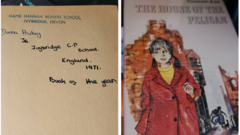
The weight of a book is more than just paper and glue. It is the weight of the hand that last held it, the breath of the person who turned the pages, and the specific, unrepeatable moment in time when those words first landed on a young mind. In 1969, a little girl named Leslie sat down with a copy of The Family Under the Bridge. She was ten years old. The world outside was a cacophony of moon landings and Vietnam protests, but inside the quiet sanctum of her local library, she was lost in the story of a cold winter in Paris.
She never finished the book. You might also find this connected coverage interesting: Avian Kleptoparasitism and the Mechanics of Opportunistic Foraging Risk.
Leslie passed away later that same year. Just like that, the music stopped. The life she was supposed to live—the decades of birthdays, first loves, and career milestones—vanished into the ether. And the library book, a mundane object of cardboard and ink, vanished too. It sat in the dark for fifty-five years, a silent witness to a life cut short, until a random afternoon in 2024 when it finally made its way home.
The Archive of Forgotten Things
Libraries are cemeteries of a sort, though we rarely think of them that way. They house the ghosts of ideas, but more importantly, they house the ghosts of our former selves. We check out a book as one person and return it as another. But what happens when the person never comes back? As discussed in recent articles by Refinery29, the effects are notable.
The book in question was Natalie Savage Carlson’s Newbery Honor-winning tale. It is a story about a homeless man in Paris who finds a family and, in doing so, finds his own humanity. It is a book about belonging. For over half a century, Leslie’s copy didn't belong anywhere. It wasn't on the library shelves, and it wasn't in her family’s hands. It was a lost relic, a small piece of a tragic puzzle that her family had long since stopped trying to solve.
Imagine the dust. Not the metaphorical dust of history, but the actual, gritty particles that settle on a bookshelf in a basement or the back of a closet. For fifty-five years, that book held a secret. It held a library card pocket with a date stamped in fading blue ink: 1969. To a stranger, it was a piece of trash, a liability, a late fee waiting to happen. To the person who eventually found it, it was a mystery.
The Phone Call from the Past
When the book finally resurfaced, it didn't arrive with a fanfare. It arrived because of a stroke of conscience. Someone, somewhere, realized that this object didn't belong to them. They returned it to the library, likely expecting a stern look or a hefty fine. Instead, they triggered a chain reaction of memory.
When the librarians saw the date, the air in the room changed. We live in an era of digital tracking and instant gratification, but there is something about a physical stamp from the Nixon administration that demands pause. They looked into the records. They traced the name. And then they did something libraries rarely do: they reached out to the family of the child who had checked it out.
Leslie’s siblings are no longer children. They are adults who have lived through the very decades their sister was denied. When they received the call, it wasn't about a book. It was about a bridge. The book was a physical link to a sister who had become a static image in a photograph, a memory that had been smoothed over by the passage of time.
Why a Late Fee is Never Just About Money
There is a logical deduction we can make about why objects like this matter. In a purely material world, a 55-year-old library book is a net loss. It’s outdated, likely smelling of mildew, and technically "stolen" property. But humans are not logical creatures. We are emotional foragers. We look for scraps of our loved ones in the things they touched.
The library, in an act of profound grace, waived the half-century of fines. But the real "payment" was the realization of what that book represented. It was the last thing Leslie was curious about. It was the last conversation she was having with the world.
Think about the last thing you touched before a major life change. A coffee mug? A set of keys? Now imagine that object being returned to your family fifty years after you are gone. It becomes a holy relic. It is the "Experience" of a life lived, however briefly, captured in a 150-page children's novel.
The Invisible Stakes of Memory
The stakes here weren't financial or even literary. The stakes were the preservation of a soul’s footprint. When the family finally held the book, they weren't looking at the illustrations of Paris. They were looking at the edges of the pages where Leslie’s fingers might have rested. They were looking at the spine she had cracked.
It is a terrifying thought: that we are all just one library book away from being forgotten. We build these massive digital lives, clouds of data and social media posts, but they are fragile. They can be deleted with a keystroke. A physical book, however, can survive in a box in a humid attic for five decades. It can wait. It is patient. It waits for someone to notice that it is out of place.
The return of the book didn't bring Leslie back. It didn't heal the wound of a child lost too soon. But it gave the family a new way to speak her name. It turned a tragedy into a story of homecoming.
The Quiet Power of the Return
We often treat the world as a series of transactions. We buy, we sell, we use, we discard. But the story of the 55-year-old book suggests a different architecture for reality. It suggests that nothing is ever truly lost if someone cares enough to look at the name on the inside cover.
The library has decided to keep the book, but not on the shelves for circulation. It is now a part of their history, a testament to the relationship between a community and its people. The family has their closure, a small, rectangular piece of 1969 that finally crossed the finish line.
As the sun sets on this story, the book sits under glass or in a protected file. It no longer smells of dust; it smells of survival. It is a reminder that our lives are composed of the stories we leave unfinished, and that sometimes, the universe conspires to bring the final chapter home, even if it takes a lifetime to get there.
The ink on the stamp has faded to a ghostly pale, but the name Leslie is as sharp and clear as the day she wrote it.